
WELCOME BONUS 300%
UP TO €2000 + 100
FREE SPINS
UP TO €2000 + 100
FREE SPINS
Home → Blackjack
Blackjack at Casino Peaches: Variants, Rules and Payouts
Blackjack Party Has Two Hosts
Blackjack Party is an Evolution live dealer game whose format pairs the standard blackjack table with two hosts who keep the action moving. Bets run from 1.00 EUR to 1,000 EUR per hand, a spread wide enough for a casual player testing the game and for a higher-stakes round alike. The two presenters commentate and interact, so the table follows the same dealing rules as any live blackjack game while the entertainment sits alongside the cards.
The house edge on a standard six-deck blackjack game with the dealer standing on soft 17, doubling after a split allowed and a 3:2 payout is 0.46%, which leaves an RTP of 99.54% when basic strategy is followed. On a 1,000 EUR stake, that edge costs about 4.60 EUR per hand on average; on a 1.00 EUR minimum bet the same edge costs roughly 0.46 cents. A 3:2 blackjack payout returns 150 EUR on a 100 EUR stake, against the 120 EUR that a 6:5 payout would give.
For a beginner, the 1.00 EUR floor matters more than the 1,000 EUR ceiling: it caps the cost of learning the flow at about half a cent per hand under the 0.46% edge, and it keeps the two-host format affordable until basic strategy is second nature. A blackjack at that table still pays 3:2, so the 100 EUR example scales down to 1.50 EUR on a 1.00 EUR bet. Insurance, at a 7.47% house edge, is the one side bet basic strategy always declines.
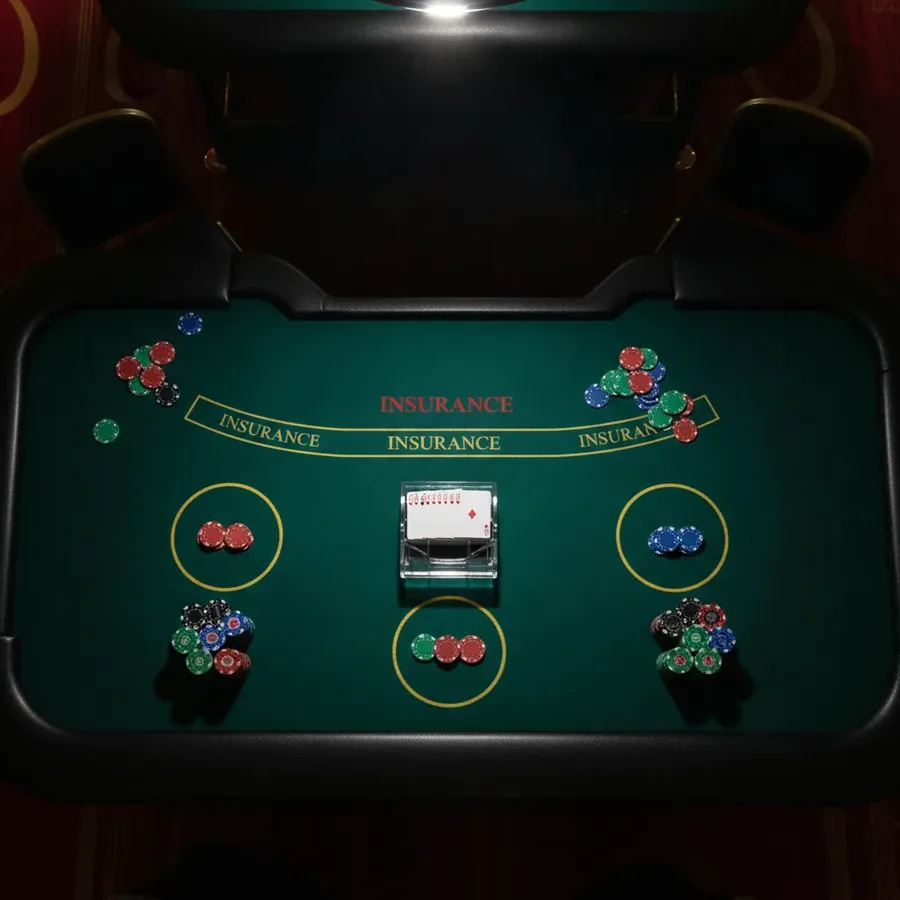
Double Down or Just Hit on 11
Doubling down on 11 against a dealer's upcard is a core basic strategy decision in the six-deck game with dealer stands on soft 17 and double down on any first two cards. The rule permits doubling after a split as well, which improves the player's return by about 0.14 percentage points compared with a table that forbids it. A double requires a stake equal to the original bet, so a 100 EUR wager becomes 200 EUR, and the player receives exactly one more card.
The choice between doubling and hitting on 11 changes the total amount at risk. A simple hit keeps the original stake in play, while a double puts twice the money on the table for a single card. The basic strategy figure of 99.54% RTP for the six-deck game assumes the player makes the correct double-down decisions, including doubling on 11 in the appropriate spots. The house edge of 0.46% is only reachable with that strategy, not by guessing.
The rule set at Casino Peaches includes double down on any first two cards and doubling after a split, which is more valuable than a table where doubling is restricted to hard totals of 9, 10, or 11 only. The effect of doubling after a split is a reduction of the house edge by roughly 0.14 percentage points. On 100 EUR staked, that rule difference is worth about 0.14 EUR in expected loss per round compared with a no-DAS table.
The Insurance Mistake: 7% Extra House Edge
Insurance in blackjack with six to eight decks carries an RTP of 92.53% and a house edge of 7.47%. It is a separate side bet of up to 50% of the main wager, offered when the dealer shows an ace, and it pays 2:1 if the dealer has blackjack. The house edge on insurance is more than sixteen times the 0.46% edge of the main six-deck game with 3:2 and basic strategy.
The 7.47% house edge on insurance means that on a 100 EUR insurance bet, the expected loss is 7.47 EUR in the long run. Basic strategy for the six-deck game always declines insurance, except for card counters at a true count of +3 or higher. With a single deck the insurance edge drops to about 5.88%, which is still far worse than the 0.15% house edge of a single-deck game with classic 3:2 rules.
Taking insurance at a six-deck table turns a 0.46% house edge main game into a much worse proposition on the side bet. The rule effect on the main game is separate: replacing 3:2 with 6:5 adds exactly 1.39 percentage points to the casino's edge, but the insurance side bet adds 7.47% on its own stake. A player who insures a 100 EUR blackjack wager with the maximum 50 EUR side bet faces an average loss of roughly 3.74 EUR on that side bet alone.
Split Aces: Only One Card per Hand
Splitting aces in the six-deck blackjack variant at Casino Peaches follows the standard rule that each ace receives only one card per hand. The split rule allows up to four hands, but split aces typically get one card each, which limits the player's ability to improve the hand. The effect of resplitting aces improves RTP by about 0.08 percentage points where the rule is offered, but the base table lists no resplit of aces.
A pair of aces split into two hands with one card each creates two soft hands that cannot be hit again or doubled. The house edge of 0.46% for the six-deck game assumes the player splits aces when basic strategy calls for it, and the rule modifier for resplitting aces is worth −0.08 percentage points to the house edge. On 100 EUR staked, that modifier is worth about 0.08 EUR per round.
Splitting aces without resplitting means the player can create at most two hands from a pair of aces, each with a single card. The Liberal Vegas Strip variant, by contrast, includes resplit aces along with late surrender, dealer stands on soft 17, and doubling after a split, reaching an RTP of 99.72% and a house edge of 0.28%. The standard deviation of that liberal game is 1.15.
Soft 17: Does the Dealer Hit or Stand?
The base six-deck blackjack game at Casino Peaches uses the rule that the dealer stands on soft 17, abbreviated S17. This rule contributes to the RTP of 99.54% and a house edge of 0.46% with basic strategy. A dealer hitting soft 17 instead would lower the player's return by 0.22 percentage points, pushing the house edge higher, since the dealer improves a weak total more often.
The difference between S17 and H17 is worth 0.22 percentage points to the house edge. On 100 EUR staked, that is an expected loss difference of 0.22 EUR per round. The rule is more favorable to the player than H17, but less favorable than the Liberal Vegas Strip set, which combines S17 with doubling after a split, resplitting aces, and late surrender for an RTP of 99.72% and a house edge of 0.28%.
Late surrender is not included in the base six-deck S17 game, but the Blackjack Surrender variant shows the effect of adding it: the player gives up the hand after the dealer checks for blackjack and loses half the stake, improving RTP by about 0.08 percentage points. Combined with S17, that modifier would move the house edge from 0.46% to roughly 0.38%. The full Liberal Vegas Strip package reaches 0.28%.
Blackjack variants at a glance
| Variant | Payout | House edge | Rule | RTP |
|---|---|---|---|---|
| Blackjack 6 decks, S17, DAS, DOA, 3:2 payout, basic strategy | Blackjack 3:2, regular win 1:1, insurance 2:1 | 0.46% | Dealer stands on soft 17; double down on any first two cards; doubling after a split allowed; no surrender. Basic strategy is required to reach this figure | 99.54% |
| Blackjack Insurance (6–8 decks) | Insurance 2:1 | 7.47% | Separate side bet of up to 50% of the main bet when the dealer shows an ace. Basic strategy ALWAYS declines it (except for card counters at a true count ≥ +3). With a single deck the edge is ≈ 5.88% | 92.53% |
| Blackjack 6:5 payout instead of 3:2 (6 decks) | Blackjack 6:5, win 1:1 | 1.85% | Replacing 3:2 with 6:5 adds exactly +1.39 percentage points to the casino's edge – more than any other rule change. On a €10 bet a blackjack pays €12 instead of €15. | 98.15% |
| Blackjack Split / double / H17 – rule effects | Double – stake ×2 with one card; split – up to 4 hands; split aces usually get one card each. | H17 +0.22 percentage points; RSA −0.08 percentage points; DAS −0.14 percentage points | Dealer hitting soft 17 lowers RTP by 0.22 percentage points; resplitting aces improves it by 0.08 percentage points; doubling after a split improves it by about 0.14 percentage points; 6 decks instead of 8 – about 0.02 percentage points. | n/a (rule modifiers) |
| Blackjack Liberal Vegas Strip (liberal rules, 3:2) | Blackjack 3:2, win 1:1 | 0.28% | The most player-friendly rule set: S17 + DAS + resplit + late surrender. Standard deviation 1.15 | 99.72% |
| Blackjack Single deck, classic rules, 3:2 | Blackjack 3:2, win 1:1 | 0.15% | Fewer decks = lower edge; one deck gives about −0.48 percentage points compared with 8 decks. Often offset by a 6:5 payout. | 99.85% |
What the Hole Card Means at a Live Table
At a live blackjack table the hole card is the dealer's second card, dealt face down, and its value decides whether the hand ends immediately. Blackjack Insurance is a separate side bet of up to 50% of the main bet, taken when the dealer shows an ace, and it pays 2:1 if the dealer then reveals a ten-value hole card. On a €10 main bet the insurance stake is €5, and a winning insurance bet returns €10, so the side bet is not a second hand but a wager on one hidden card.
Insurance carries an RTP of 92.53% and a house edge of 7.47%, and the house edge is the average share of each stake that the casino keeps over the long run. Basic strategy always declines insurance, because the €5 side stake loses €0.37 on average per decision at that 7.47% edge, while the same €5 left on the main hand is not exposed to that cost. Card counters treat it differently and take insurance only at a true count of +3 or higher.
The number of decks changes the insurance maths. With a single deck the edge on the insurance bet falls to roughly 5.88%, against 7.47% in a six-deck or eight-deck shoe, because a single deck holds a larger proportion of ten-value cards once an ace is exposed. That is 5.88% of €5, or about €0.29 lost per insurance decision, instead of €0.37.
Clicked Too Late? The Hand Stands Automatically
Live blackjack runs on a decision clock, and once the window closes the hand is held as it stands and the round continues without further input. Blackjack Party from Evolution sets a bet range of 1.00 - 1,000 EUR, and at the top of that range a single missed decision freezes €1,000 in a hand the player can no longer split, double or surrender. The held hand then plays out against the dealer under the table's standing rules.
The cost of a missed decision depends on the rule set in force. A dealer who hits soft 17 lowers RTP by 0.22 percentage points, while doubling after a split improves it by about 0.14 percentage points and resplitting aces improves it by 0.08 percentage points. A player who cannot act loses the chance to take the split or the double, so the 0.14 percentage points tied to doubling after a split never enters the round.
Quantum Blackjack Plus Live from Playtech accepts bets from 1 EUR to 5,000 EUR and carries an RTP of 99.57% with optimal strategy, which means the player acts on every decision the rules allow. At a 99.57% return, €100 of stakes costs about €0.43 on average across many rounds, but that figure assumes the double and split options are actually used. A held hand breaks that assumption and shifts the round toward the weaker side bet outcomes.
Which Rule Variants the Software Shows
The rule set is displayed on the table itself, and the payout line is the first item to read. A blackjack that pays 3:2 returns €15 on a €10 bet, while a 6:5 table pays only €12 on the same €10 bet, and replacing 3:2 with 6:5 adds exactly 1.39 percentage points to the casino's edge. That single line is worth more than any other rule change on the felt, so a 6:5 table at 98.15% RTP sits well below a 3:2 table.
Deck count and dealer behaviour follow. Blackjack Single deck, classic rules, 3:2 reaches an RTP of 99.85% with a house edge of 0.15%, because one deck gives about 0.48 percentage points more than eight decks. Six decks instead of eight is worth about 0.02 percentage points. Blackjack Liberal Vegas Strip, with S17, DAS, resplit and late surrender, lands at 99.72% RTP and a 0.28% house edge, and its standard deviation is 1.15.
Surrender rules appear on some layouts and not others. Blackjack Surrender, the late version, lets the player give up the hand after the dealer has checked for blackjack and take back 50% of the stake, which improves RTP by about 0.08 percentage points. Early surrender is worth much more, up to 0.6 percentage points, but it is extremely rare. Blackjack 6 decks, S17, DAS, DOA, 3:2 payout with basic strategy reaches 99.54% RTP and a 0.46% house edge.
Even Money only possible with Dealer Ace
Even money is offered only when the dealer's upcard is an ace and the player holds a blackjack, and it pays 1:1 on the spot instead of the usual 3:2. On a €10 bet the certain return is €10, while a 3:2 blackjack would pay €15 if the dealer fails to draw a ten-value card. The gap between the two outcomes is €5, and that €5 is the price of removing the risk that the dealer also has blackjack.
The alternative is the insurance side bet, which is capped at 50% of the main bet and pays 2:1. A €10 blackjack with a €5 insurance bet returns €10 from the insurance when the dealer has blackjack, so the main bet pushes and the player breaks even, exactly as with even money. Insurance carries an RTP of 92.53% and a house edge of 7.47%, and basic strategy always declines it except for card counters at a true count of +3 or higher.
The dealer's own rule set decides how often the ace upcard turns into blackjack. A dealer who hits soft 17 lowers RTP by 0.22 percentage points, and that rule applies to the same tables where even money is offered. Taking even money on a €10 blackjack locks in €10; declining it and standing pat leaves the €15 payout live whenever the dealer's hole card is not a ten-value card.
Bet Two Percent of Your Bankroll per Hand
A disciplined starting point for bet sizing uses two percent of the bankroll per hand, so a €500 bankroll places €10 per round. At that stake the house edge on Blackjack 6 decks, S17, DAS, DOA, 3:2 payout, basic strategy works out to 0.46%, which is €0.046 lost per €10 hand on average.
Over 100 hands the same €10 flat bet puts €1,000 of money at risk and costs about €4.60 in expected value, because the house edge is the average share of each stake the casino keeps. On the Blackjack Liberal Vegas Strip rule set the edge drops to 0.28%, so the same 100 hands average €2.80 instead of €4.60.
Beginners who raise the stake after a loss push the effective risk above two percent, and the 6:5 payout is the sharpest trap: a €10 blackjack pays €12 instead of €15, and that single change adds 1.39 percentage points to the house edge. The two percent rule only holds if the payout stays at 3:2.
RNG Deals From a Virtual Eight-Deck Shoe
In the RNG version the software draws cards from a virtual eight-deck shoe, and the deck count drives the price of the game. Going from 8 decks to 6 decks improves the return by roughly 0.02 percentage points, while a single deck is worth about 0.48 percentage points compared with 8 decks.
The payout rule matters far more than the shoe size. Blackjack 6 decks, S17, DAS, DOA, 3:2 payout, basic strategy returns 99.54% with a 0.46% house edge, whereas the same 6-deck game paying 6:5 returns 98.15% with a 1.85% edge. On a €10 bet that difference is €3 per blackjack: 3:2 pays €15, 6:5 pays €12.
Beginners should check the payout before the deck count. A single deck with classic rules and 3:2 pays 99.85% RTP, the highest figure here, but the same single deck is often paired with 6:5, which erases the advantage. Insurance is a separate side bet of up to 50% of the main bet and returns only 92.53%, so basic strategy always declines it.
The Shoe, the Cut Card and 75% Penetration
Penetration describes how far the cut card sits from the end of the shoe. At 75 percent penetration, three of every four cards are dealt before the shuffle, and with an eight-deck shoe that means 312 of 416 cards enter play. The remaining 104 cards are cut away.
High penetration stretches the useful life of one shoe. Compared with 50 percent penetration, which deals only 208 cards, a 75 percent shoe gives roughly 50 percent more rounds before the next shuffle, and each extra round carries the same 0.46% house edge as Blackjack 6 decks, S17, DAS, DOA, 3:2 payout, basic strategy.
The cut card also sets how much of the shoe a card counter can observe, which is why the late surrender option exists as a safety valve: it returns 50% of the stake and improves RTP by about 0.08 percentage points. Beginners rarely track penetration, but it decides how many hands per hour the table actually produces.
Calling Late Surrender Correctly in Three Steps
Late surrender lets the player give up the hand after the dealer has checked for blackjack and lose half the stake. The rule is worth about −0.08 percentage points on the house edge, so a €10 hand returns €5 when surrendered instead of the full stake at risk.
Step one is to confirm the dealer has no blackjack, because early surrender is a different rule and is extremely rare. Step two is to apply it only against a strong dealer upcard, using basic strategy rather than instinct. Step three is to log the result, since the modifier moves 0.46% down by 0.08 points on the Blackjack 6 decks, S17, DAS, DOA, 3:2 payout, basic strategy game.
The gain is small but real: on 100 surrendered hands at €10 each, the rule saves roughly €0.80 in expected value compared with playing every hand out. Blackjack Liberal Vegas Strip already includes late surrender inside its 99.72% RTP and 0.28% house edge, so no separate registration step is needed there.
Splitting at a Live Table, Step by Step
A split turns one hand into up to four hands, and each new hand carries its own stake, so a €10 bet becomes €20, €30 or €40 at risk. Doubling after a split improves the return by about 0.14 percentage points, and resplitting aces adds 0.08 percentage points on top.
Split aces usually receive one card each, which caps the upside of that specific split. A beginner at Blackjack Party who splits a €10 pair now has €20 committed, and if the dealer hits soft 17 the H17 rule costs another 0.22 percentage points of return on both hands.
Contact
Live - online chat
Banking









Providers












Casino Peaches 2026